Aslim Taslam’s refusal to negotiate
All the Old KnivesAslim Taslam’s refusal to negotiate is more than a hard bargaining position: it is a declared organizational rule that closes off compromise and makes the threatened deaths aboard Royal Jordanian Flight 127 part of the group’s leverage. The novel presents the rule both as doctrine, grounded in a previous act of mass self-destruction, and as an operational constraint that leaves officials deciding between meeting the demands and attempting a dangerous assault.
Doctrine and precedent
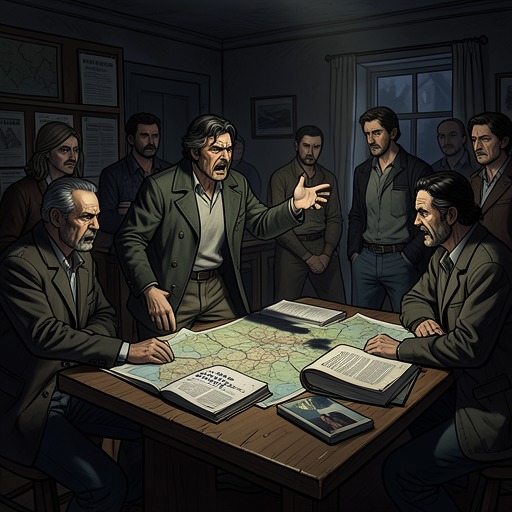
During a briefing on the hijacking, Henry Pelham identifies Aslim Taslam’s manifesto as the source of its refusal to accept anything less than its demands. Drafted in Tehran in March 2004 and sent by email from Mogadishu, the manifesto sets out what the group will and will not do. Henry argues that its members would kill themselves rather than accept a lesser outcome, and cites Kinshasa as evidence: there, they detonated an incendiary device inside the central police station, killing those inside and themselves. The prior attack makes the rule appear credible within the briefing, though the characters are assessing what the group has done before, not proving what it will do next.
Henry’s certainty distinguishes his reading from Ernst Pul’s initial suggestion that the authorities begin with negotiation. Henry contends that Aslim Taslam has already settled the question in its manifesto; he describes the group as acting without ambiguity or retreating from its word. His colleagues do not all share his confidence or expertise, but Owen Lassiter accepts the immediate consequence of the assessment: either Austria and Germany release the prisoners, or everyone aboard the plane may die.
The demand and its stakes
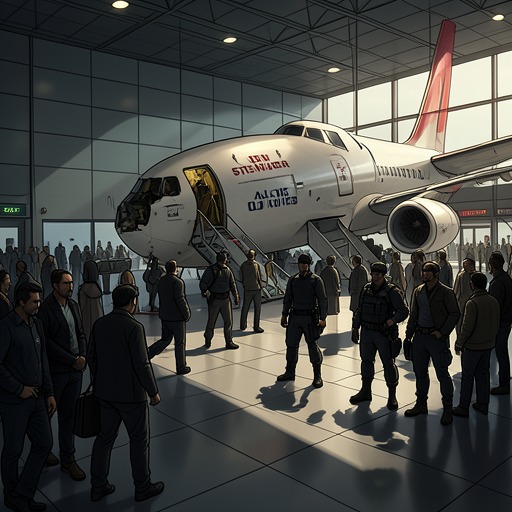
The hijackers seize Royal Jordanian Flight 127 after it lands in Vienna, having traveled from Amman. The Airbus A319 carries 120 passengers and crew, and the group demands the release of five prisoners within forty-eight hours: two held in Austria and three in Germany. The authorities are also told that seventeen Americans and twenty-nine Germans are aboard, figures that give the crisis international and political stakes beyond the hostages’ immediate safety.
The group’s first message to passengers combines reassurance with an explicit threat. It says the plane will serve as a safe house until the demands are met, denies an intention to use the aircraft as a weapon, and promises that everyone will be released afterward. But the promise is conditional. The hijackers move nine children, aged five to twelve, to the front of the cabin as human shields and warn that a child will die if anyone interferes. The stated refusal to compromise is thus reinforced by a specific threat against the hostages, making any attempt to force entry potentially catastrophic.
A rule under pressure
The deadline shapes the authorities’ operational choices. With forty-two hours remaining, Owen argues that they must either accept the demands or storm the plane before time runs out. Vick replies that the Americans are advising the Austrian authorities, not conducting the assault themselves. The distinction leaves them trying to influence a decision whose consequences will fall on the people aboard the aircraft.
The presence of television cameras adds another constraint. Celia Favreau points out that ORF crews are watching from the airport fence and that the hijackers deliberately sought outside attention. If the Austrian authorities push reporters back, she reasons, newscasters may infer that an assault is being prepared. The group’s public visibility therefore complicates secrecy around any attempt to challenge its control of the plane.
A later message attributed to Ahmed Najjar further undermines the assault plan: it reports a camera attached to the aircraft’s underside and warns that the attackers know what they are doing, urging the authorities to meet their demands. The message is not treated as unquestionably reliable. The team realizes that the sender’s identifier may be readable on the phone, or that Ahmed may have been forced to surrender it; he may have been discovered, killed, or displaced by whoever now controls the device. The report heightens the perceived danger of an assault without resolving who sent it.
The declaration made real
The rule becomes an explicit message to the authorities when the plane’s engine starts. The aircraft does not move, but the Austrians receive the words, “Aslim Taslam does not negotiate.” High-resolution cameras trained on the cockpit record both pilots dying in their seats. They have not been shot; they have suffocated. The deaths make the refusal immediate and credible, while the stationary plane and running engine leave the authorities facing a threat whose next step is still uncertain.
The episode makes the phrase function as both a statement of policy and an act of coercion: it tells the authorities what the group claims it will do while narrowing the time and choices available to them. Its force rests on the combination of the manifesto, the precedent in Kinshasa, the hostages used as leverage, and the deaths visible in the cockpit. The resulting dilemma is not simply whether negotiation is possible, but whether any action can be taken without triggering the consequences the group has announced.